
There is an undeniable charm to Toronto’s older neighborhoods. Whether it’s a red-brick Victorian in Cabbagetown or a sturdy post-war bungalow in East York, these homes have character that modern builds just can’t replicate. But behind the lath-and-plaster walls often lies an electrical system designed for a completely different era.
If your home was built before 1980, its wiring was likely designed to handle a toaster and a radio not a modern ecosystem of EV chargers, induction stoves, and home offices. While the “bones” of your house are strong, the nervous system might be failing.
At Astron Electric, we have specialized in Toronto’s older housing stock since 1970. With over 55 years of experience, we don’t just fix wires; we preserve homes. We understand the unique challenges of retrofitting heritage properties without destroying their architectural beauty. If you love your vintage home but worry about what’s behind the walls, this guide is for you.
Why Older Toronto Homes Have Unique Electrical Challenges
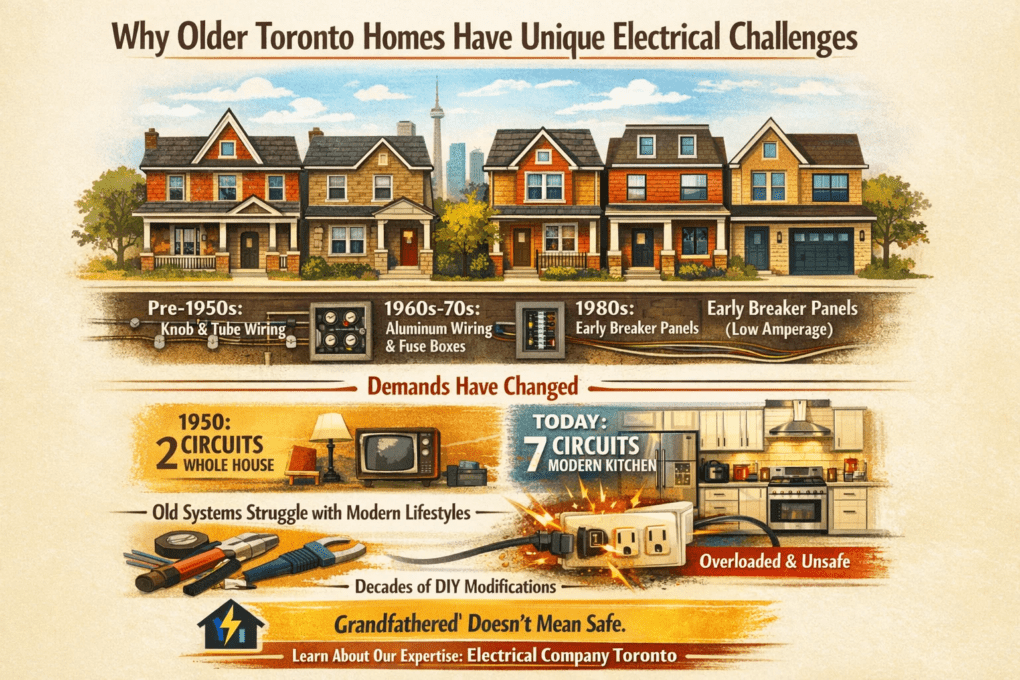
Toronto’s housing history is a tapestry of different eras, each with its own electrical “standard.”
- Pre-1950s: The era of Knob and Tube.
- 1960s-70s: The era of Aluminum Wiring and Fuse Boxes.
- 1980s: The beginning of modern breakers (but often with low amperage).
The problem isn’t necessarily that the workmanship was bad back then; it’s that the demands have changed. In 1950, a home might have had two circuits for the whole house. Today, a single kitchen renovation might require seven dedicated circuits.
When you plug a 2025 lifestyle into a 1950 electrical system, you push components beyond their safe limits. While existing systems are often “grandfathered” (meaning you aren’t legally forced to upgrade them just because the code changed), “legal” does not always mean “safe.” Decades of DIY modifications by previous owners often compound the risk.
- Learn about our expertise: Electrical Company Toronto
Problem #1: Knob and Tube Wiring (Pre-1950s Homes)
What Is Knob and Tube Wiring?
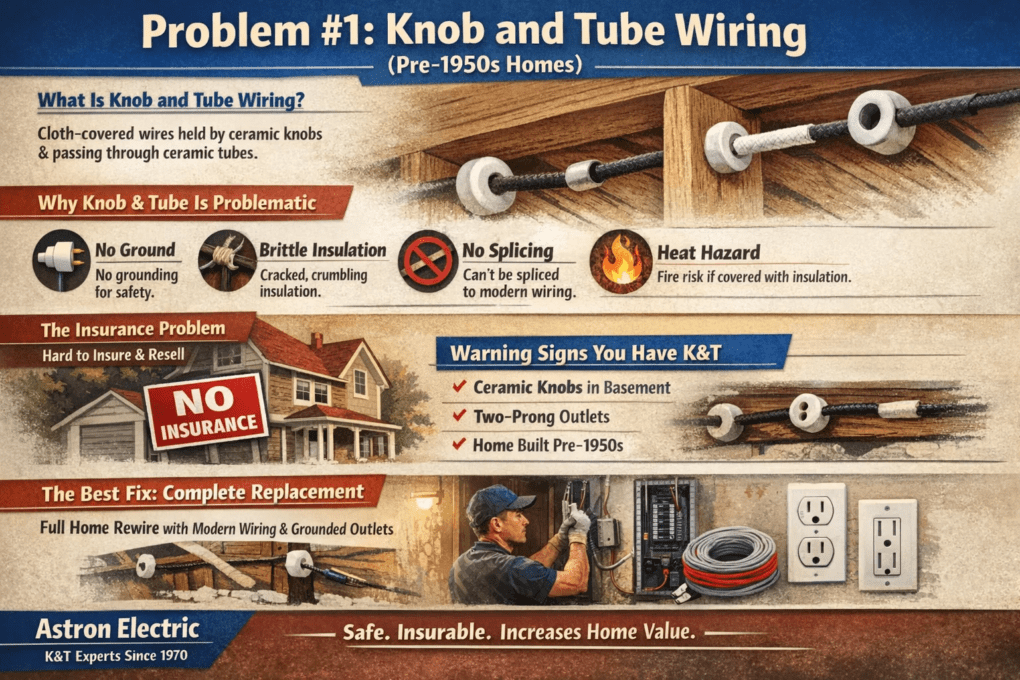
If your home was built before the early 1950s common in High Park, The Annex, and East York you likely have Knob and Tube (K&T). This system uses cloth-covered wires running parallel to each other, anchored by ceramic “knobs” and passing through ceramic “tubes” in the wood framing.
Why Knob and Tube Is Problematic
While it was state-of-the-art in 1930, K&T is a major liability today.
- No Ground: It cannot be grounded, meaning your modern electronics are at risk.
- No Splicing: It cannot be safely spliced into modern grounded circuits.
- Brittle Insulation: The rubber and cloth insulation dries out and crumbles over 70+ years, exposing live wires.
- Heat Trap: It was designed to release heat into the open air. If previous owners blew insulation into the walls/attic over the wires, that heat is trapped, creating a fire hazard.
The Insurance Problem
This is usually where homeowners hit a wall. Most Ontario insurance companies will refuse to insure a home with active Knob and Tube, or they will charge exorbitant premiums. If you are selling, K&T is a “deal killer” that often forces a significant price reduction.
Warning Signs You Have It
- You see ceramic knobs in the unfinished basement ceiling or attic.
- Your outlets are all two-prong (no ground hole).
- The home was built pre-1950.
The Best Fix: Complete Replacement
There is no “repair” for Knob and Tube; it must be replaced.
Why Partial Removal Fails: Connecting modern wire to old K&T is dangerous and leaves hidden hazards behind walls. Plus, insurance companies usually demand a letter confirming 100% removal.
The Professional Solution: We perform a complete home rewire using modern Romex cable. This includes installing a new panel and grounded three-prong outlets.
- Timeline: Typically 5-10 days.
- Value: It significantly increases resale value and ensures insurability.
Astron Electric Specialty: “Since 1970, Astron Electric has specialized in K&T replacement in Toronto’s older neighborhoods. We know how to fish wires through lath-and-plaster walls to minimize damage, preserving your home’s original character.”
Problem #2: Outdated or Insufficient Electrical Panel (Service Upgrade Needed)
Understanding Electrical Service Capacity
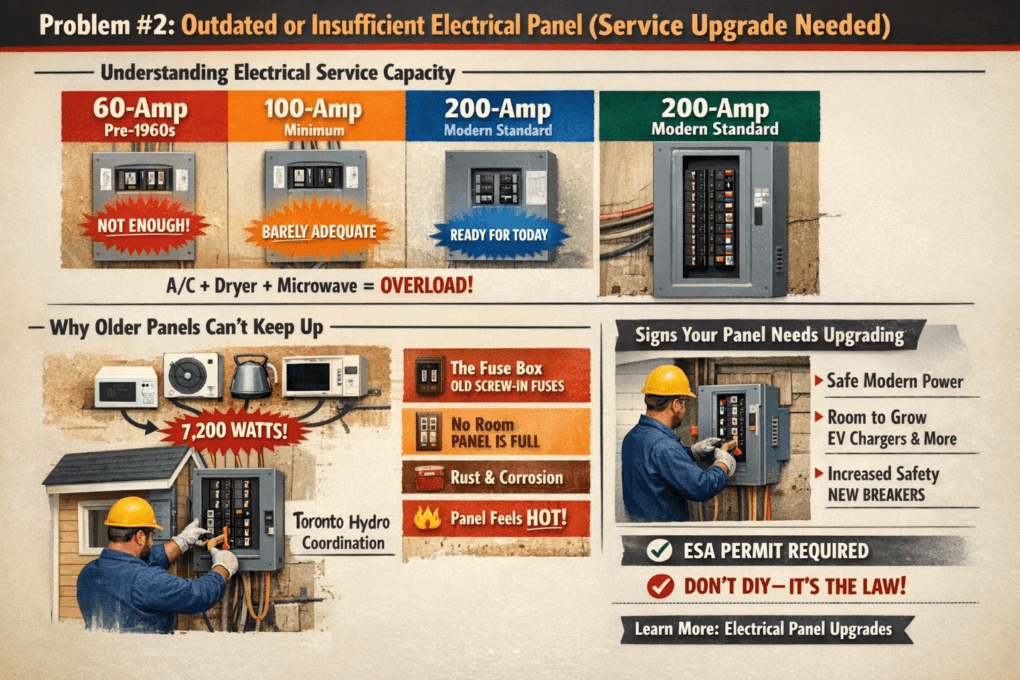
- 60-Amp: Common in pre-1960s homes. Grossly inadequate for today.
- 100-Amp: The bare minimum, but often struggles with A/C and electric dryers.
- 200-Amp: The modern standard.
Why Older Panels Can’t Keep Up
Do the math: A 60-amp service provides roughly 7,200 watts of power. A central A/C unit and an electric dryer running together can easily pull that much. Add a microwave, a computer, and a kettle, and you are overloading the main feed.
Signs Your Panel Needs Upgrading
- The Fuse Box: If you have screw-in fuses instead of flip-switches, your technology is 60+ years old.
- No Room: The panel is full, so you can’t add circuits for a renovation.
- Rust/Corrosion: A sign of water damage or extreme age.
- Warmth: The panel feels hot to the touch (Warning: This is dangerous).
The Best Fix: Service and Panel Upgrade
This isn’t a DIY job. It involves coordinating with Toronto Hydro to cut the power at the street, replacing the “stack” (pipe) outside your house, and installing a new breaker panel inside.
Benefits:
- Safe operation of modern appliances.
- Room to grow (EV chargers, hot tubs).
- Increased safety with modern breakers.
Professional Requirement: Panel upgrades require ESA permits and Toronto Hydro coordination. DIY panel work is illegal and voids your insurance.
- Learn More: Electrical Panel Upgrades
Problem #3: Aluminum Wiring (1960s-1970s Homes)
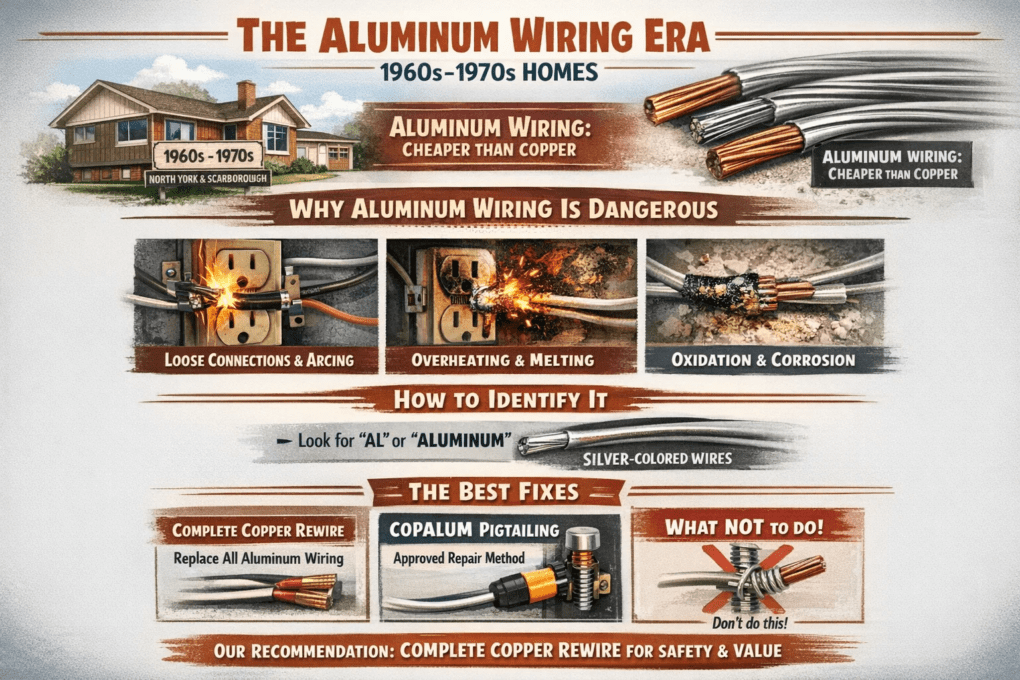
The Aluminum Wiring Era
If your home was built or renovated between the mid-60s and mid-70s (common in North York and Scarborough subdivisions), you likely have aluminum wiring. It was used as a cheaper alternative to copper.
Why Aluminum Wiring Is Dangerous
Aluminum is a softer metal than copper. It expands and contracts significantly when heated (like when current flows through it). Over time, this cycle causes the connection screws to loosen.
- Loosening = Arcing: A loose wire sparks (arcs), which creates intense heat and can melt the device or start a fire.
- Oxidation: Aluminum rusts (oxidizes) differently than copper, creating resistance and heat.
How to Identify It
Look at the exposed wiring in your basement or panel. The wire jacket may say “AL” or “ALUMINUM,” and the wire itself will be silver-colored, not the orange/copper color you are used to.
The Best Fixes: Multiple Options
- Complete Copper Rewire (Best): Replacing all aluminum with copper eliminates the risk entirely. This is the gold standard for safety and value.
- COPALUM/Pig-tailing (Approved Repair): Using specialized, high-pressure crimping tools to attach a piece of copper wire to the end of the aluminum wire. This allows you to connect to devices safely. Note: This requires special certification and tools.
- What NOT to do: Never simply wrap aluminum wire around a standard copper-rated outlet screw. It will fail.
Expert Recommendation: Based on 55+ years of experience, we typically recommend complete copper rewiring for long-term safety and peace of mind.
Problem #4: Two-Prong Outlets (Lack of Grounding)
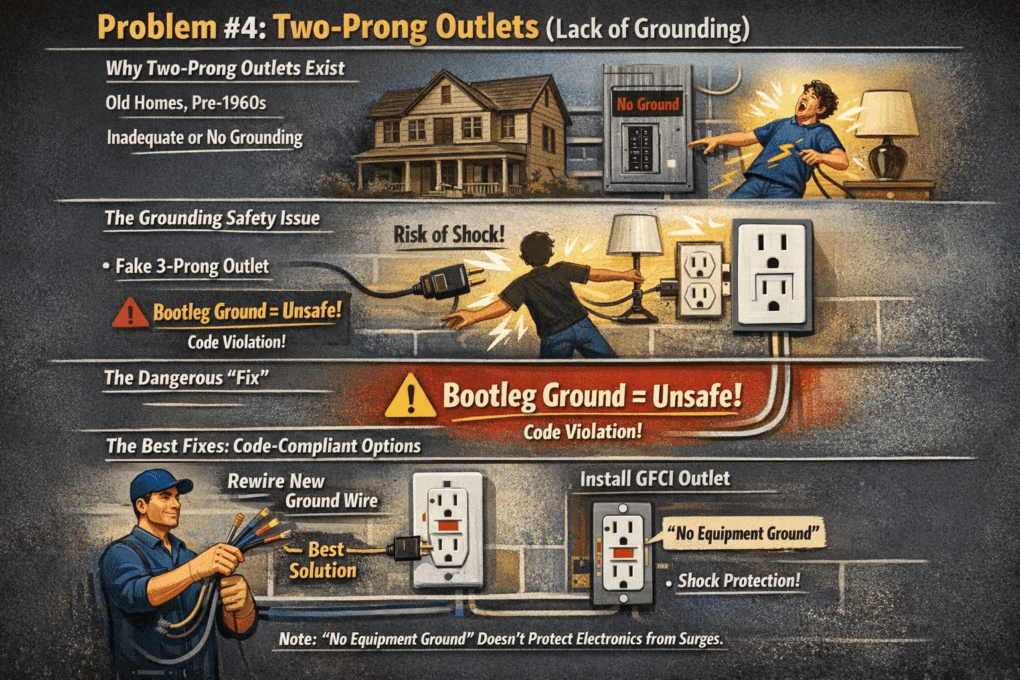
Why Two-Prong Outlets Exist
Before the mid-60s, grounding wasn’t standard. Older panels often have inadequate or nonexistent grounding.
The Grounding Safety Issue
Grounding provides a safe path for stray electricity to go into the earth rather than through your body. Without it, you are at higher risk of shock, and surge protectors for your TV/Computer won’t work.
The Dangerous “Fix”
Never simply replace a two-prong outlet with a three-prong outlet without adding a ground. This is a “bootleg ground” or simply an ungrounded three-prong outlet. It tricks you into thinking it’s safe, but it’s a code violation and a hazard.
The Best Fixes: Code-Compliant Options
- Rewire (Best): Run new wire with a ground wire.
- GFCI Retrofit (Code Approved): You can install a GFCI (Ground Fault Circuit Interrupter) outlet. It monitors the current and cuts power if a shock hazard is detected.
- Note: It must be labeled “No Equipment Ground.” It protects you from shock, but it doesn’t protect sensitive electronics from surges.
Problem #5: Insufficient Number of Outlets and Circuits
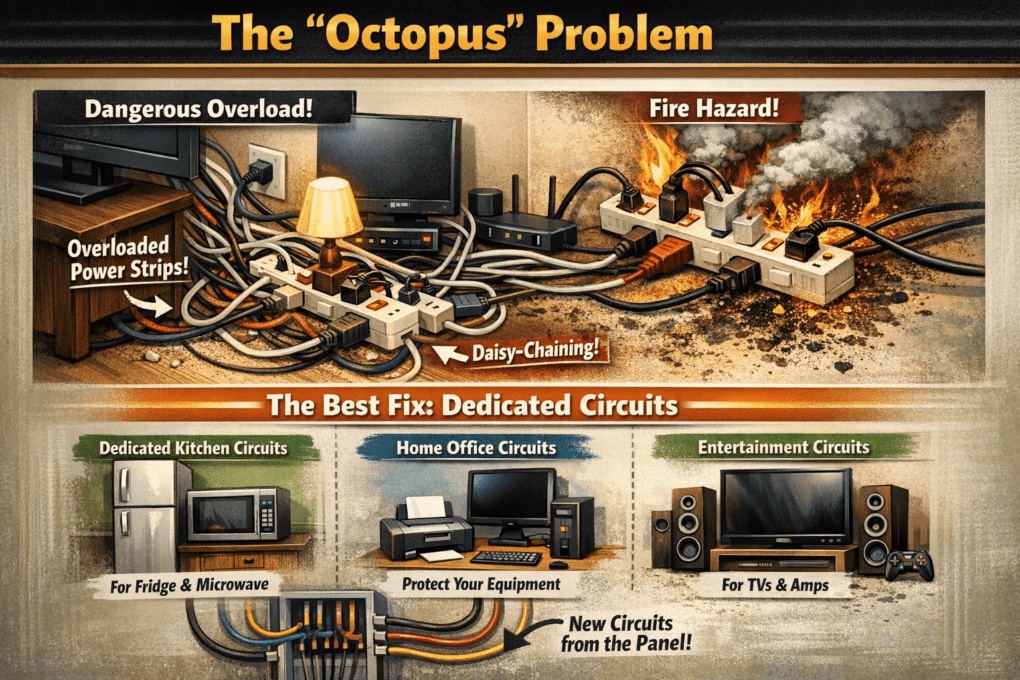
The “Octopus” Problem
In 1950, one outlet per room was luxury. Today, you have a TV, soundbar, router, lamp, and phone charger all in one corner. This leads to the “Octopus” a dangerous tangle of extension cords and power strips.
The Danger
Power strips have load limits. When exceeded, they can cause electrical issues. Daisy-chaining them (plugging a strip into a strip) creates major resistance and fire risk.
The Best Fix: Dedicated Circuits
We don’t just cut holes and add plugs. We run new circuits from the panel.
- Dedicated Kitchen Circuits: For the fridge and microwave.
- Home Office Circuits: To protect your computer equipment.
- Entertainment Circuits: To handle high-draw amps and TVs.
Problem #6: Frequently Tripping Circuit Breakers
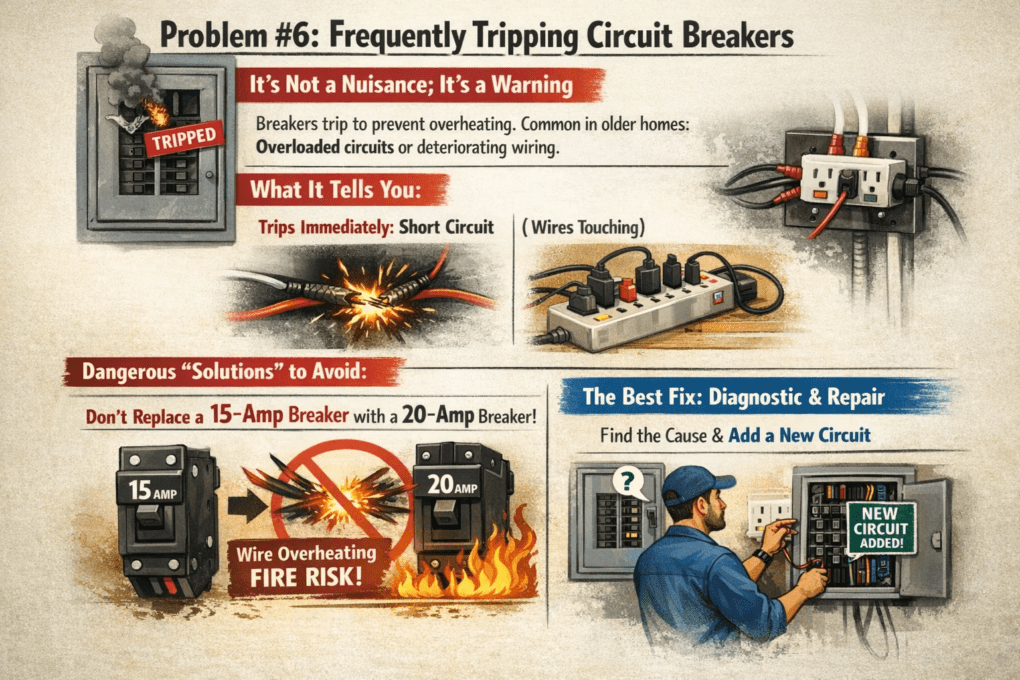
It’s Not a Nuisance; It’s a Warning
Breakers are designed to trip to prevent wires from melting. If they trip, they are doing their job. Common causes in older homes include overloaded circuits or deteriorating wiring.
What It Tells You
- Trips immediately: Usually a short circuit (wires touching).
- Trips after 10 minutes: Usually an overload (too much stuff plugged in).
Dangerous “Solutions” to Avoid
Never replace a 15-amp breaker with a 20-amp breaker to “stop the tripping” without verifying the wire gauge. If the wire inside the wall is rated for 15 amps, putting 20 amps through it will cause it to catch fire before the breaker trips.
The Best Fix: Diagnostic & Repair
We identify why it’s tripping. Usually, the solution is adding a new circuit to split the load, rather than forcing one old circuit to do all the work.
Problem #7: Flickering or Dimming Lights
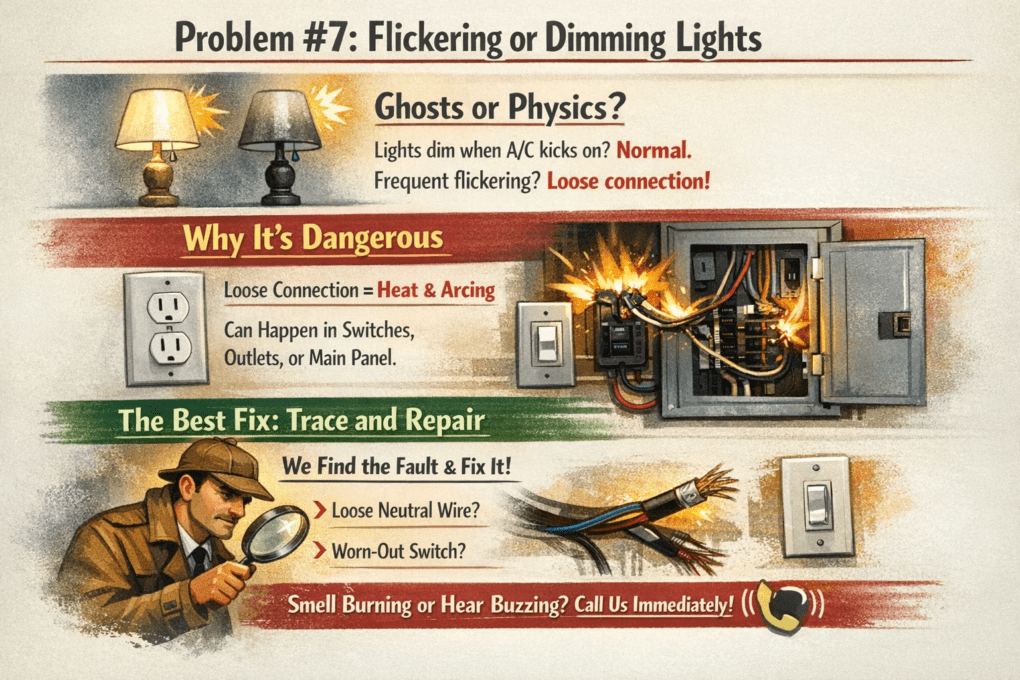
Ghosts or Physics?
If your lights dim briefly when the A/C kicks on, that’s normal voltage drop. But if lights flicker unexpectedly or persistently, it indicates a loose connection.
Why It’s Dangerous
A loose connection creates heat (arcing). This can happen inside a switch, at the outlet, or even inside the main panel.
The Best Fix: Trace and Repair
This requires a detective. We trace the circuit to find the fault. Often, it’s a loose neutral wire or a worn-out switch. If you smell burning or hear buzzing associated with the flickering, call us immediately.
Problem #8: Lack of GFCI and AFCI Protection
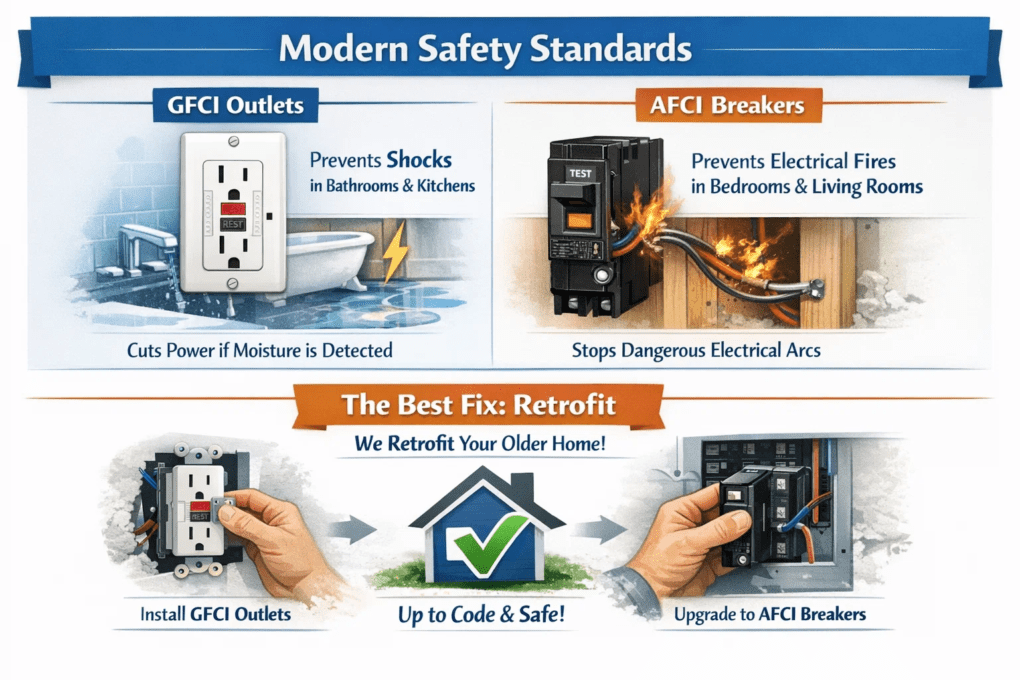
Modern Safety Standards
Older homes lack two modern life-saving technologies:
- GFCI (Ground Fault Circuit Interrupter): Prevents electrocution in wet areas (Bathrooms/Kitchens). GFCI detects current imbalances and shuts down circuits if moisture is sensed.
- AFCI (Arc Fault Circuit Interrupter): Prevents fires by detecting dangerous arcing (sparking) inside walls.
The Best Fix: Retrofit
We can retrofit your older home by installing GFCI outlets in bathrooms and kitchens, and replacing standard breakers with AFCI breakers to protect your bedroom and living room circuits. This brings your older home up to modern safety standards.
When to Call a Professional: Warning Signs
If you see these red flags, do not wait:
- Burning smell (fishy/plastic odor).
- Buzzing sounds from outlets or walls.
- Warm wall plates.
- Sparks when plugging in devices.
- Black/Brown marks on outlets.
Emergency Contact:
- East: (416) 422-3865
- West: (416) 929-1700
- Astron Electric provides 24/7 emergency service.
Why Older Toronto Homes Need Specialized Expertise
The Astron Electric Advantage
Rewiring a modern condo is easy. Rewiring a 1920s East York semi-detached home with original crown molding and lath-and-plaster walls is an art form.
Since 1970, Astron Electric has mastered this art.
- Minimal Damage: We fish wires through cavities to save your walls.
- Heritage Care: We respect the architecture.
- Complete Solution: We handle the permits, the Hydro coordination, and the patching.
“Our electricians understand how these homes were built and how to modernize them safely while respecting their character. We’ve obtained ESA approval on every single knob and tube replacement since 1970.”
The Cost of Fixing Electrical Problems in Older Homes
Investment vs. Expense
Think of electrical upgrades not as a repair bill, but as an investment in your home’s equity.
- Knob & Tube Removal: Essential for resale and insurance.
- Panel Upgrade: Adds immediate functionality and value.
- Rewiring: Extends the life of your home by 50+ years.
While costs vary based on home size, investing in a safe electrical system consistently pays for itself through lower insurance premiums, higher resale value, and the prevention of catastrophic fire damage.
Frequently Asked Questions About Older Home Electrical Problems
How do I know if my older Toronto home needs electrical work?
If your home is over 40 years old and has never been inspected, it needs an assessment. Warning signs include two-prong outlets, fuse boxes, or flickering lights.
Can I do electrical upgrades myself to save money?
No. In Ontario, complex work like panel upgrades or rewiring requires ESA permits. DIY mistakes in older homes (like burying junction boxes) are major fire hazards and will void your insurance.
Will insurance cover electrical upgrades?
Generally, insurance covers damage (like a fire) but not maintenance. However, once you replace Knob and Tube or Aluminum wiring, your premiums will often drop significantly.
Do I need to replace all wiring if some is problematic?
It depends. If you have Knob and Tube, yes, it all needs to go. If you have some ungrounded outlets, we might be able to run specific new lines without a full gut.
How long does it take to rewire an older Toronto home?
A typical full home rewire takes 5-10 days. We work room-by-room to minimize disruption to your daily life.