
Furniture companies used to shoot everything. Twenty-three SKUs meant twenty-three photo sessions, each running $2,800–$4,200 depending on the studio and photographer’s day rate in major markets. Then someone had to coordinate shipping, styling, lighting setup. One scratched tabletop during transport could blow the entire schedule.
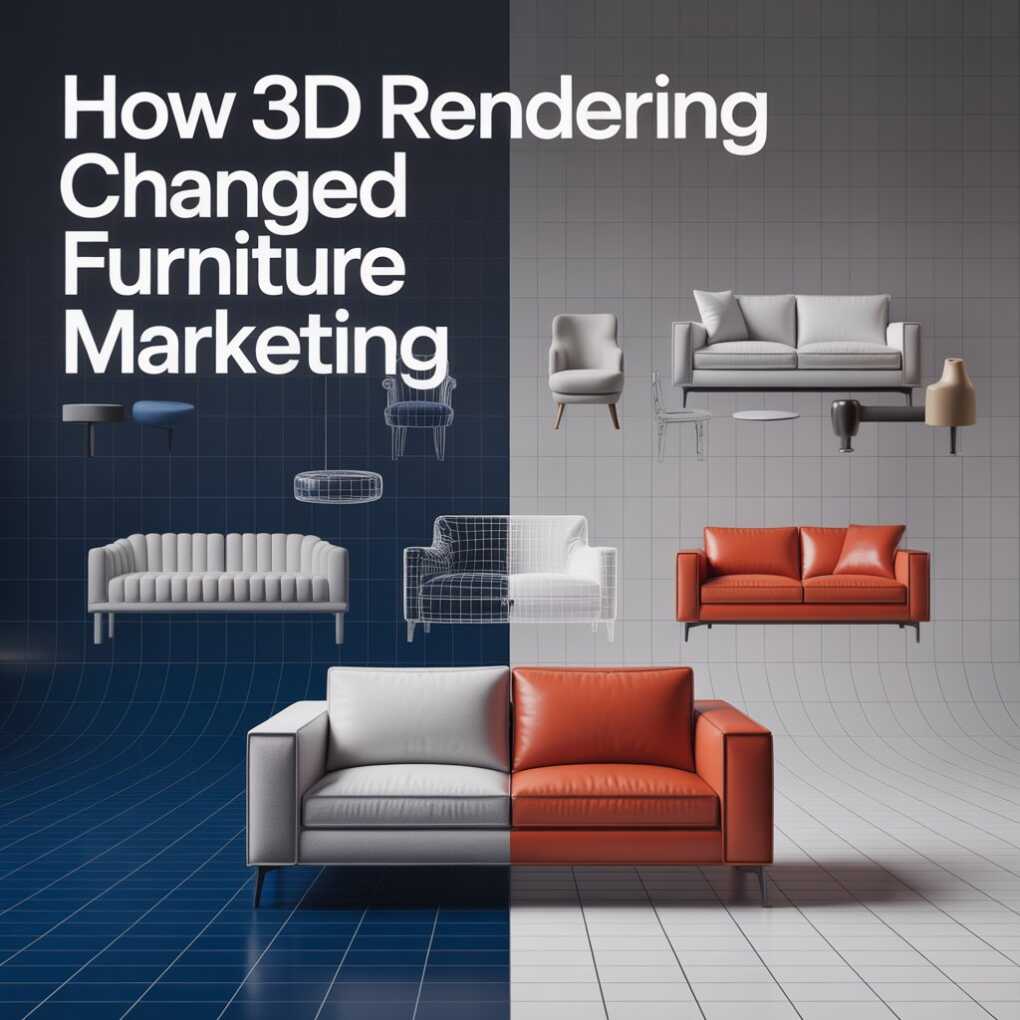
Why traditional photography costs more than the day rate
A mid-sized furniture manufacturer in North Carolina spent $47,000 on product photography last spring. That’s just shooter fees and studio time. Logistics added another $8,300 – prototype shipping both ways, insurance, rush fees when a chair arrived damaged and they needed a replacement overnighted from the factory in Vietnam.
The hidden cost sits in iteration. Client wants to see the sofa in beige instead of charcoal? That’s another shoot day, another $3,500 minimum. Maybe they approve it, maybe they don’t. 3D rendering changes that equation completely – materials swap in fifteen minutes, camera angles adjust without flying anyone anywhere.
Architectural Digest reported in their 2024 industry survey that 73% of furniture retailers now use CGI for at least half their product imagery, up from 41% just two years prior.
But cost isn’t why companies switch. It’s timelines.
Traditional workflow: design approved, prototype built (4–6 weeks), shipped to photographer (another week if domestic, three if overseas), shoot scheduled around everyone’s availability, images delivered 5–7 days post-shoot for retouching. You’re looking at three months minimum from final design to usable marketing assets. Rendering collapses that to two weeks. Designer exports the CAD file, rendering team builds materials and lighting, client reviews iterations, final images render overnight on a farm running 40+ GPUs.
Technical details that actually matter in production
Here’s what separates amateur rendering from work that fools the human eye.
Subsurface scattering – light penetrates the surface, bounces around inside the material, exits somewhere else. You see it in wax, jade, skin, certain plastics. Cheap renderers skip it because computation costs spike. The difference shows up immediately in anything translucent or organic. Leather without proper subsurface looks like painted plastic.
Real studios track four light types minimum: key, fill, rim, and ambient occlusion. Then they add HDRI environment maps captured from actual locations. A living room scene might use a 16K resolution HDRI shot in a Stockholm apartment at 3 PM in October – specific sun angle, specific weather, specific color temperature bleeding through those windows.
Furniture designer in Austin spent six hours adjusting one camera angle last month. Moved it 2.3 degrees, everyone finally signed off. Cost breakdown: $1,200 for two point three degrees of rotation. Nobody blinked because the alternative was reshooting.
Texture resolution matters more than polygon count for furniture. A dining table might run only 18,000 polygons but need 8K texture maps for wood grain – that’s where realism lives. The rendering engine samples those textures thousands of times per pixel using physically-based rendering algorithms that simulate actual material properties: roughness, metalness, index of refraction.
- Real-time rendering – Unreal Engine and similar tools now hit photorealistic quality at 60 frames per second, mainly for configurators where customers swap finishes and see results instantly
- Path tracing – simulates individual light rays bouncing through a scene, same physics as reality, produces the most accurate results but renders slower
- Hybrid approaches – combining rasterization for speed with ray tracing for reflections and shadows, common in e-commerce applications where thousands of products need consistent output
McKinsey reported in their 2023 manufacturing study that 58% of furniture producers now create marketing materials before physical prototypes exist. The product launches while the factory is still tooling up.
Where rendering outperforms and where it doesn’t
Fabrics still give renderers trouble. A linen sofa with that irregular, lived-in texture – you can nail it in CGI but it takes serious shader work. Displacement mapping, anisotropic roughness, fiber-level detail. Then someone sits on the physical version and it wrinkles completely differently than the simulation predicted.
According to Furniture Today’s 2024 technology report, rendering budgets in the furniture industry jumped 340% between 2021 and 2024, while photography budgets dropped 28% in the same period.
Glass and metal? Rendering wins every time. Ray-traced reflections calculate exactly how light bounces off a chrome chair leg or passes through a glass tabletop. Photographers spend hours trying to control reflections with diffusion screens and carefully positioned flags. The renderer just calculates physics.
E-commerce platforms prefer rendering because consistency is guaranteed. Same lighting, same color accuracy, same everything across 400 SKUs. Photography variables stack up – different shoot days mean different weather, different times mean different natural light, different photographers mean different styles even with detailed shot lists.
Some companies hybrid it now. They shoot hero images for emotional appeal, lifestyle context, that tangible feeling photography still delivers better. Technical specs, alternate finishes, detail shots – all rendered. Keeps costs reasonable while maximizing each medium’s strengths.
The workflow integration matters more than the rendering itself. A furniture company in Denmark integrated their PLM system directly with their rendering pipeline. Designer updates a dimension in the CAD file, rendering automatically regenerates all affected images overnight, marketing wakes up to current assets without touching anything. That’s where ROI really happens – not in cost per image but in organizational efficiency.
Resolution requirements keep climbing. Four years ago, 2K was standard for web. Now it’s 4K minimum, 8K for large-format print, and some luxury brands want 16K masters for future-proofing. Rendering scales easily – just adjust output settings and wait longer. Photography doesn’t scale backward, ever.
Virtual photography is its own discipline now. Camera settings in 3D software mirror real equipment: focal length, aperture, shutter speed, ISO. Rendering artists think like photographers – they compose shots, consider depth of field, choose lenses based on the distortion characteristics they want. Technical differences blur as the tools mature.