
Floating bathroom vanities look simple in photos. Clean lines, a neat basin, that small shadow gap underneath — the kind of detail often shown in design magazines with one towel, one plant, and not much else.
For a while, it is easy to think they are mainly about style.
But after seeing a few apartment renovations, compact guest bathrooms, and small hotel rooms up close, it becomes clear why designers keep returning to wall-mounted units. A floating vanity can solve real space problems. It can also create new ones if the size, wall structure, plumbing, and storage are not checked properly.
That is the part the photos usually leave out.
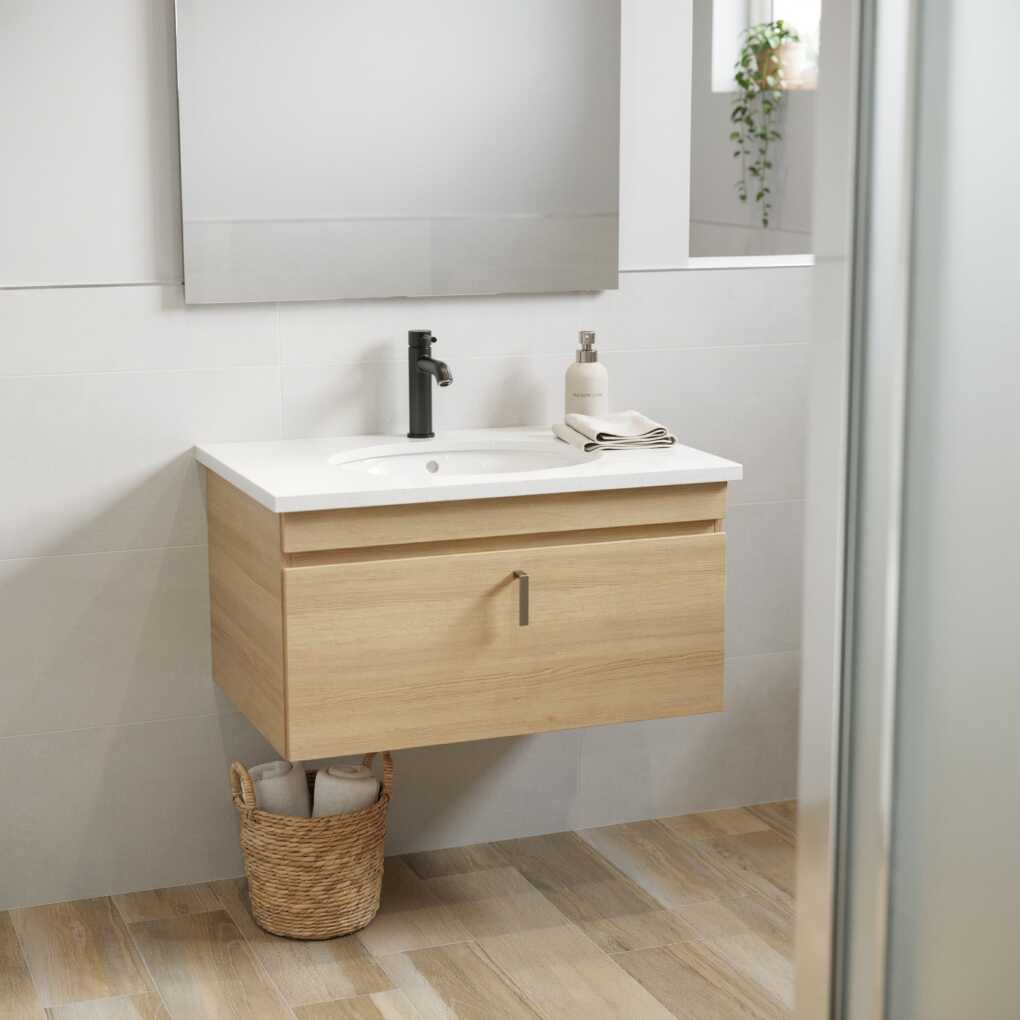
The Real Reason They Work Is Not the Style
The open floor beneath a floating vanity does not add square footage. A small bathroom is still a small bathroom. But it changes how the room is read visually.
When floor tile continues under the cabinet, the bathroom stops feeling like a narrow corridor with furniture pushed into it. This is especially noticeable in older apartments, powder rooms, and bathrooms where the walkway is already tight.
In one compact apartment bathroom, the room was only about 1.8 metres wide. A standard floor-standing cabinet would have made the walkway feel heavy and closed in. A wall-mounted unit left visible floor underneath, and that small gap made the room feel easier to move through.
The shadow line below the vanity helps too. It is subtle, but in a tight bathroom, subtle things often matter more than dramatic design choices.
Where It Goes Wrong: Looks First, Function Second
A floating vanity can look beautiful and still be frustrating to use.
One common problem is choosing a shallow cabinet because it looks light in photos, then realizing it cannot hold the things people use every day. A hairdryer, spare toiletries, cleaning spray, and folded towels need real drawer space. If the cabinet is too shallow, those items usually end up on the windowsill, the toilet tank, or the countertop.
Another common issue is plumbing. A vanity may have deep drawers on the product page, but the waste pipe may cut directly through the top drawer space. When that happens, the drawer layout often has to be modified, and the final storage is not as useful as expected.
Before choosing the finish, check the unglamorous details first: drain height, water supply position, drawer depth, pipe layout, wall structure, and the installation height of the sink. These details are boring. They are also what separate a vanity that works from one that only photographs well.
Storage Is the Problem Nobody Wants to Talk About
Small bathrooms rarely fail because the tile color is wrong. They fail because every surface becomes storage.
The toothbrush charger lives beside the soap. Spare toilet paper sits on top of the cistern. Cleaning spray ends up in the shower because there is nowhere else for it to go.
This is why open shelves are risky in small bathrooms. They look calm in showroom images with two rolled towels and a small plant. In daily use, they often collect half-empty bottles, contact lens cases, spare razors, and other things nobody wants on display.
Drawers are usually more forgiving. A floating vanity with two deep drawers can hide more daily clutter than a larger cabinet with open shelving or awkward internal dividers. For rental properties and guest bathrooms, this also makes cleaning easier. The room can be reset quickly because fewer things are left sitting out.
The Sink and Countertop Should Be Treated as One Decision
The basin and cabinet are often chosen separately, but in a small bathroom they should be treated as one decision.
A vessel sink may look beautiful on its own but leave almost no usable counter space. A basin that is too far forward can make the walkway uncomfortable. A countertop with too many joints or edges can also make cleaning harder than it needs to be.
For compact bathrooms, it can be easier to start with bathroom vanity with sink options where the cabinet, basin, countertop depth, and mirror size are planned as one set. There is still room to compare styles, but a coordinated vanity set reduces the chance of choosing parts that look fine individually and awkward together.
Width gets most of the attention, but depth is often what people feel in daily use. A 900mm vanity may fit the wall perfectly. If it is too deep for the room, the bathroom will still feel cramped. Before confirming any vanity, it helps to sketch the walking path, door swing, towel rail position, and the space needed in front of the basin.
The Mirror Is Not an Afterthought
Many small bathroom plans spend too much time on the vanity and too little time on the mirror.
A mirror that is too small makes the wall feel unfinished. A mirror that is too wide can look strange if it extends beyond the vanity or conflicts with wall lights. In bathrooms with little natural light, the mirror area also becomes part of the room’s lighting plan, whether that was intended or not.
LED mirrors can help in darker bathrooms, but color temperature matters. Very cool light can make warm tiles and wood finishes feel harsh. For many residential bathrooms, a range around 3000K to 4000K feels more balanced: warm enough for a home, clear enough for daily grooming.
Mirror cabinets are useful when storage is limited. They add space for small items without adding another cabinet to the floor. In a narrow bathroom, that can be the difference between a calm counter and a cluttered one.
Texture Helps, but Too Much Makes the Room Busy
Small bathrooms often tempt people to overdesign. Because the room is small, every surface starts to feel like an opportunity: ribbed cabinet front, patterned floor, feature wall, brass hardware, stone countertop.
Each of those choices can work. The problem is using all of them together.
A safer rule is to let one element carry the texture and keep the rest quieter. If the floor tile has movement, the vanity can be plain. If the walls are simple, the cabinet front can carry more detail.
A ribbed bathroom vanity set works best when it is allowed to be the main detailed element in the room. Paired with a simple basin, a plain mirror shape, and neutral walls, the texture adds depth without making the bathroom feel smaller.
Showrooms can handle more visual complexity because they are large, empty, and controlled. A real bathroom at 7 a.m. on a weekday usually benefits from more restraint.
The Wall Matters More Than People Expect
A floating vanity is only as good as the wall behind it.
This is the part homeowners and designers sometimes leave too late. A wall-mounted unit has to support the cabinet, basin, countertop, stored items, and daily pressure from people leaning on it. A weak partition wall may hold an empty cabinet during installation but struggle once the bathroom is in use.
Solid masonry, reinforced stud walls with backing, or properly prepared support boards are usually better suited for wall-mounted vanities. If the wall is weak and reinforcement is not practical, a floor-standing unit may be the better choice. That is not a downgrade. It is choosing the right product for the site conditions.
Installation height also matters. Too low, and the floating effect is almost wasted. Too high, and the sink becomes uncomfortable. Clearance under the vanity should be enough for mopping or a robot vacuum, but not so much that the basin feels oddly high.
When One Bathroom Becomes Ten
For a single home renovation, buying a retail vanity can be straightforward. Measure the wall, check the plumbing, choose a style, and adjust on site if needed.
Multi-room projects are different.
Apartment renovations, boutique hotels, rental properties, and small development projects often need the same visual language across different bathroom sizes. One room may have space for a 1000mm unit. Another may only allow 750mm. Some bathrooms may need mirror cabinets because there is no other storage. Others may need LED mirrors because the room has poor natural light.
If every cabinet, basin, countertop, and mirror is chosen separately, finishes can start to drift. Whites may not match. Basin proportions may vary. Mirror sizes may feel inconsistent. The final result can look accidental instead of planned.
This is not only about where the vanity is made. It is about whether the supplier can handle variation within a coordinated system. Some suppliers can adjust sizes and configurations while keeping the same design language. Others only sell fixed catalogue pieces. For multi-unit work, that difference matters.
Mistakes Worth Avoiding
Do not choose the widest vanity just because the wall has room for it. Leave space for door swing, towel rails, cleaning, and the reality that two people may need to move around the room.
Do not assume floating always means space-saving. Some wall-mounted units are still deep and visually heavy. The floating design helps, but the actual dimensions still matter.
Do not ignore plumbing until installation day. A drawer layout may look perfect until the pipe cuts through the middle of it.
And do not treat the mirror as a separate decision. In a small bathroom, the mirror, light, and vanity usually read as one visual unit. If the mirror feels wrong, the whole wall feels wrong.
Final Thoughts
A floating vanity will not save a badly planned bathroom. It will not fix poor lighting, weak walls, awkward plumbing, or a layout that never worked in the first place.
But when the size is right, the drawers actually function, the sink does not fight the walkway, the mirror belongs on that wall, and the wall can support the installation securely, a floating vanity can make a small bathroom feel much easier to live with.
The best ones are not always the most dramatic. They are the ones that still look calm after months of real mornings, real mess, and real cleaning. That is harder to achieve than it looks — and it is the real reason floating vanities keep showing up in good small-bathroom plans.