
You do not need to guess, and you definitely do not need to buy the biggest fan on the shelf. The right ceiling fan size usually comes from four things working together: your room’s square footage, your ceiling height, your room shape, and the airflow the fan can deliver. Current guidance from ENERGY STAR, Hunter, Home Depot, and Lowe’s lines up on the big idea: small rooms need smaller blade spans, medium rooms sit in the middle, and large or open rooms often need either a bigger fan or more than one fan. As checked on March 12, 2026, ENERGY STAR’s Product Finder listed 1,311 certified ceiling fan records, including 188 marked Most Efficient, so you have lots of options now—but also more chances to buy the wrong size if you shop by looks alone. [ENERGY STAR Product Finder, checked March 2026; ENERGY STAR basics; Hunter; Home Depot; Lowe’s]
Quick answer: if your room is under about 75 sq ft, look around 29–36 inches. Around 76–144 sq ft, look around 36–42 inches. Around 144–225 sq ft, you will usually shop in the 44-inch zone or a nearby equivalent. Around 225–400 sq ft, you are commonly in the 50–54 inch or 52–59 inch range, depending on the guide and the room layout. Over 400 sq ft, you should start thinking about 60–71 inches or multiple fans. That is the short version. The useful version is below! [ENERGY STAR, current page; Home Depot, 2025 guide; Lowe’s buying guide; Hunter sizing page]
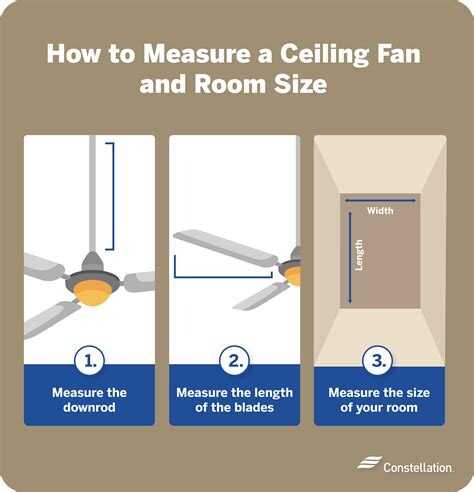
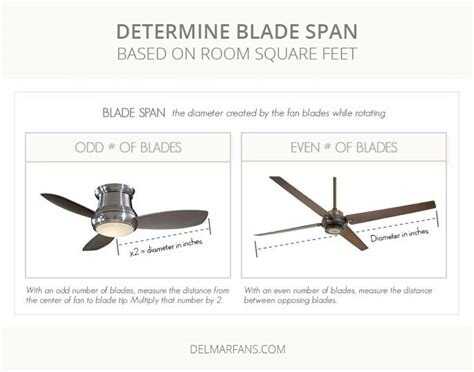
Key takeaway: ceiling fan “size” usually means the blade span, also called the sweep or diameter. Think of it like a bird’s wingspan: tip to tip is the number that matters most when you are matching a fan to a room. [Home Depot; Hunter]
Why getting the size right matters more than most people think
A fan that is too small can feel disappointing right away. It spins, it lights up, and yet the room still feels still and stuffy. A fan that is too large can create a draft where you do not want one, dominate a small room visually, or leave you dealing with awkward wall clearance. Size is not only about appearance. It is also about comfort, safety, noise, and whether the fan actually moves air where you sit, sleep, cook, or relax. ENERGY STAR also notes that proper installation height matters, and the U.S. Department of Energy says using a ceiling fan can let you raise the thermostat by about 4°F without reducing comfort, so choosing well is about function as much as style. [ENERGY STAR basics; DOE Fans for Cooling]
Check 1: Start with square footage, not guesswork
This is your first move every time. Measure the room’s length and width, then multiply them. Home Depot’s measuring guide uses exactly this method and even gives a simple example: a 12 × 15 ft room equals 180 sq ft. If your room is L-shaped, split it into two rectangles, calculate each one, then add them together. That sounds boring, but it is the step that keeps the rest of your decision clean and easy. [Home Depot, published January 30, 2025]
Formula 1: Room area = length × width
In plain language, this just means “how much floor space are you actually trying to serve?” If your guest room is 10 × 10 ft, that is 100 sq ft. If your living room is 18 × 20 ft, that is 360 sq ft. Those two rooms should not be shopping in the same fan aisle, even if both happen to have an 8-foot ceiling.
Everyday example: if your home office is 11 × 12 ft, you are at 132 sq ft. That puts you in the medium-room range, where a fan around 36–42 inches is the usual starting point. If your den is 12 × 15 ft, you are at 180 sq ft, which pushes you into the next band. Already, your shortlist gets much smaller. Useful, right? [ENERGY STAR; Hunter; Home Depot]
| Room area | Good starting fan size | Typical room | Quick note |
|---|---|---|---|
| Up to 75 sq ft | 29–36 in | Small nook, tiny bedroom | Do not overpower the room |
| 76–144 sq ft | 36–42 in | Bedroom, office | A very common sweet spot |
| 144–225 sq ft | 44 in and up | Main bedroom, medium living room | Boundary zone: compare layout too |
| 225–400 sq ft | 50–54 in or 52–59 in | Large living room | Check shape before buying one huge fan |
| Over 400 sq ft | 60–71 in or multiple fans | Great room, open-plan area | One fan is not always best |
This chart blends the more granular ENERGY STAR and Hunter room bands with the broader Lowe’s and Home Depot shopping bands, which is why the 225–400 sq ft row shows a range rather than one exact number. [ENERGY STAR; Hunter; Home Depot; Lowe’s]
Check 2: Use the size chart, then respect the boundary zones
This is where many people get tripped up. Real rooms often sit right on the line. A 12 × 12 ft room is 144 sq ft, which is exactly where several guides shift from the medium zone to the next size band. Home Depot places 42 inches in rooms up to 144 sq ft and 44 inches for 144–225 sq ft. Hunter also moves from 36–44 inches up to 44 inches or more as the room gets bigger. Lowe’s uses broader retail bands and says rooms up to 225 sq ft can take a fan up to 51 inches. So, what should you do at the boundary? Use the room’s real life, not just the math. [Home Depot; Hunter; Lowe’s]
If the room is closed off, lightly used, and has a standard 8-foot ceiling, staying near the lower end of the band is often fine. If the room opens into a hall, runs warm in summer, gets afternoon sun, or simply feels airless, leaning a bit bigger is often the smarter pick. Bigger is not always better, but at the boundary, a little extra span can make daily comfort feel much easier.
Scenario 1: your child’s room is 10 × 10 ft. A compact fan around 36–42 inches feels balanced and leaves the room visually calm.
Scenario 2: your main bedroom is 12 × 12 ft. You are right on the fence. A 42-inch model can work, but a slightly larger option can make sense if the room feels stuffy or opens into another space. The chart gives you the lane; your room’s behavior gives you the final answer. [Home Depot; Lowe’s; Hunter] :contentReference[oaicite:8]{index=8}
Scenario 3: your living room is 18 × 20 ft, or 360 sq ft. You are not in small-fan territory anymore. This is where 52–59 inches becomes a normal starting point, and you should also ask whether one fan can actually cover the sitting area and the far end of the room well. [Lowe’s; Home Depot]
Check 3: Let ceiling height overrule the box
You can pick the perfect blade span and still end up with poor results if the fan hangs too low or sits too close to the ceiling. ENERGY STAR says ceiling fans should be mounted in the middle of the room, at least 7 feet above the floor and at least 18 inches from the walls. If the ceiling height allows it, the best placement is usually 8–9 feet above the floor for stronger airflow. Home Depot also notes that fan blades should have at least 8 inches of clearance from the ceiling for good airflow. [ENERGY STAR; Home Depot]
This is why low-profile or flush-mount fans make sense for lower ceilings, while downrods make sense for higher ones. Home Depot says ceilings above 9 feet should use a downrod-style setup, and Hunter’s support team gives a very simple rule for calculating downrod length. [Home Depot; Hunter Support]
Formula 2: Downrod length ≈ ceiling height − 9 ft
In everyday language, you are trying to bring the fan down into the “comfort zone,” not leave it floating too high. If your ceiling is 12 ft, then 12 − 9 = 3 ft, so a 36-inch downrod is the rough target. Hunter gives exactly that example. [Hunter Support]
| Ceiling height | Best mounting style | Target blade height | Easy choice |
|---|---|---|---|
| Under 8 ft | Low-profile / flush mount | At least 7 ft above floor | Keep the fan compact and safe |
| 8–9 ft | Standard mount | 8–9 ft above floor | Usually the easiest setup |
| Over 9 ft | Downrod mount | 8–9 ft above floor | Lower the fan into the airflow zone |
| Sloped / vaulted | Downrod plus proper adapter if needed | Keep clearances safe | Measure twice before you order |
These height rules come directly from current guidance on clearance and optimal installation height. [ENERGY STAR; Home Depot; Hunter]
Key takeaway: if you have bunk beds, tall family members, tall cabinets, or a room where people stand on stools often, ceiling height matters even more. A fan that is technically “allowed” can still feel annoyingly low in daily life.
Check 4: Read the room shape, not just the number
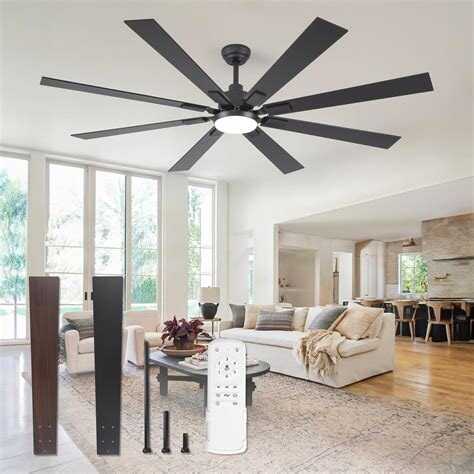
Square footage is the starting line, not the whole story. A square bedroom and a long open-plan room can have the same area but need different fan strategies. Home Depot says larger rooms may need more than one fan, and Lowe’s treats rooms over 400 sq ft as great-room territory where 60–71 inches is common. In real homes, a long room often feels better with two smaller fans placed well than one giant fan parked in the center where half the airflow misses the people. [Home Depot; Lowe’s]
Picture a long combined dining-and-living space. One oversized fan above the sofa may leave the dining end feeling dead. Two matched fans can spread airflow more evenly and also look more intentional. The same logic applies to a covered patio, a garage gym, or a basement family room with two activity zones. This is one of the biggest “why does this still feel stuffy?” problems people run into after installation.
There is also a simple visual trick that helps. Before you buy, use painter’s tape on the floor or ceiling to mark the fan’s diameter. A taped circle makes the size suddenly feel real. It is one of the easiest, fastest ways to catch a fan that is going to look huge in a small bedroom or weirdly tiny in a big living room.
| Decision method | What you do | Typical DIY time | Best for |
|---|---|---|---|
| Area chart | Measure room and match size band | 2–3 min | Fast first shortlist |
| Tape mock-up | Mark the fan diameter with painter’s tape | 5 min | Checking visual fit and wall clearance |
| Ceiling-height check | Confirm blade-to-floor and blade-to-ceiling space | 3–5 min | Avoiding low-hanging mistakes |
| Current-fan comparison | Measure your old fan’s span and judge its performance | 3 min | Replacing a fan you already know |
Practical rule: use the area chart to narrow choices, then use the tape mock-up and ceiling-height check to stop yourself from making an expensive visual or comfort mistake.
Check 5: Use airflow and efficiency as the tie-breaker
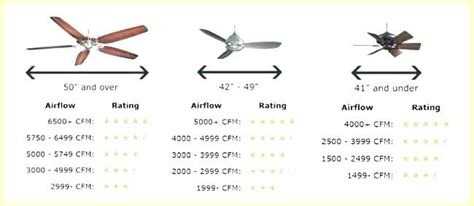
Once you are choosing between two or three sizes that all fit the room, look at airflow. Lowe’s defines CFM as cubic feet per minute, which is simply how much air the fan moves in one minute. Think of it as the fan’s “air-moving muscle.” Size still comes first, but when two fans are both the right span, better airflow can make the better choice feel obvious. [Lowe’s buying guide]
Efficiency matters too. ENERGY STAR says certified ceiling fans can be up to 44% more efficient than conventional fans, and the Department of Energy says a ceiling fan can let you raise your thermostat setting by about 4°F without reducing comfort. That does not mean any random fan saves the day. It means a properly sized, properly placed, reasonably efficient fan gives you a much better shot at comfort without leaning so hard on air conditioning. [ENERGY STAR; DOE Fans for Cooling]
Another useful correction to an old belief: more blades do not automatically mean better airflow. Lowe’s explicitly says the look and number of blades are more of a design feature, while airflow depends on things like blade pitch. So if you are stuck between a stylish five-blade fan and a plainer one with stronger airflow numbers, do not assume prettier blades mean better performance. Sometimes they do not. [Lowe’s buying guide]
If you are choosing between AC and DC motors, Lowe’s says DC fans usually start faster, use less energy overall, offer more speeds, and are often quieter. That does not change the room-size math, but it can absolutely change how happy you are with the fan every night in a bedroom or office. [Lowe’s buying guide]
Check 6: Match the fan to the room’s real job
A bedroom fan and a patio fan may be similar in size, but they are not always the same kind of purchase. For outdoor or damp spaces, Lowe’s says you need the correct rating: dry-rated for indoor-only use, damp-rated for covered outdoor areas or humid spaces, and wet-rated for places that can take direct rain. This matters a lot. A perfectly sized indoor fan is still the wrong fan for a wet patio. [Lowe’s buying guide]
Bedroom: you usually want quiet operation, enough airflow for the bed area, and a size that does not visually crowd the room.
Living room: you often want a slightly stronger presence and enough span to serve the seating zone, not just the very center.
Kitchen or breakfast area: a compact fan can work well, but watch clearances around cabinets and islands.
Covered patio: size it like the room, but only buy a damp- or wet-rated model as the location requires. [Lowe’s; Hunter sizing page]
Here is a relatable example. If you are choosing for a 14 × 18 ft covered patio, you are looking at 252 sq ft. The room-size math points you to a bigger fan than a bedroom would need, but the purchase is not finished until you check the moisture rating. This is exactly the kind of detail that separates a smart buy from a “why is this rusting already?” headache.
Check 7: Avoid the 5 mistakes that cause buyer’s remorse
Mistake 1: buying by photo only. A fan can look sleek online and still be badly undersized for your room. Product photos are terrible at showing scale. Use your room measurements first. Always.
Mistake 2: ignoring wall and floor clearance. ENERGY STAR says keep the fan at least 7 ft above the floor and at least 18 in from the walls. If you skip that check, even a correctly sized fan can perform badly or feel unsafe. [ENERGY STAR basics]
Mistake 3: using flush mount when the room really needs a downrod. Home Depot warns that low-profile “hugger” fans may not move as much air as standard fans. So if your ceiling is high enough for a downrod, do not automatically choose flush mount just because it looks neat in the listing photo. [Home Depot, 2025 guide]
Mistake 4: assuming one giant fan beats two well-placed fans. In long or split-use rooms, that is often false. Home Depot notes that larger rooms may need more than one fan, and that is exactly why open-plan spaces can feel uneven with a one-fan strategy. [Home Depot; Lowe’s]
Mistake 5: forgetting the mounting box and support. Lowe’s says you should make sure a suitable electrical box designed for a ceiling fan is available before installation, and many fans require a metal outlet box. This is not the glamorous part of shopping, but it is the part that keeps your nice new purchase safely attached to the ceiling. [Lowe’s buying guide]
Key takeaway: the wrong fan size is usually not caused by one big dramatic error. It is caused by a few small skipped checks—room area, ceiling height, wall clearance, room shape, and usage type. Fix those, and the decision gets much easier.
A very simple buying path you can use today
If you want the easiest no-drama process, do it in this order. First, measure the room and calculate square footage. Second, choose a size band. Third, confirm floor, wall, and ceiling clearances. Fourth, ask whether the room shape calls for one fan or two. Fifth, compare airflow, efficiency, and noise only among the fans that have already passed the first four checks. That order works because it follows cause and effect: the room decides the size, the ceiling decides the mount, and only then should features decide the winner.
This is also where many buyers save themselves money. Instead of scrolling through hundreds of models, you are suddenly comparing maybe five. That feels lighter, faster, and much less confusing.
6 links worth opening before you buy
- ENERGY STAR Ceiling Fan Basics — an official page with room-size guidance, floor clearance, wall clearance, and mounting basics you can use while shopping.
- U.S. Department of Energy: Fans for Cooling — a plain-English government guide explaining how fans improve comfort and why they can let you raise the thermostat by about 4°F.
- Home Depot: How to Measure for a Ceiling Fan — a very practical measuring guide with examples for room area, blade span, ceiling height, and downrod use.
- Hunter Fan: Ceiling Fan Sizes for Any Room — an easy shopping guide that helps you map common room sizes to blade spans without overcomplicating it.
- Lowe’s Ceiling Fan Buying Guide — useful for room-size bands, outdoor damp/wet ratings, CFM basics, motor types, and installation reminders.
- Wikipedia: Ceiling fan — a quick background page if you want the simplest overview of what a ceiling fan does and how it differs from air conditioning.
Conclusion: the right ceiling fan size should feel obvious once you ask the room the right questions
If you remember only three things, remember these. First, measure the room. Second, respect ceiling height and clearance. Third, treat airflow and features as tie-breakers, not starting points. That one shift alone saves a lot of frustration.
The best ceiling fan is not the most expensive one, the trendiest one, or the one with the most dramatic product photo. It is the one that fits your room, hangs at the right height, clears the walls, matches the room’s job, and moves enough air where you actually live. Once you get that right, the room feels better every single day—and that is the whole point.
So before you click “buy,” grab a tape measure, do the two easy formulas, and make the room prove what it needs. You will shop faster, avoid common mistakes, and end up with a ceiling fan that feels convenient, comfortable, and just right.