
You know the feeling: your room is clean, modern, calm, and almost done, but the ceiling fan choices online look either too builder-basic, too shiny, too fussy, or weirdly futuristic. Then you find one that looks gorgeous, but the specs are confusing. Is it too small? Too low? Too dim? Too loud? That is where most people get stuck.
A good modern ceiling fan should do two jobs at once. It should quietly disappear into the room’s design when you want calm, and it should earn its place when the weather turns warm. A ceiling fan cools you by moving air across your skin; it does not lower the room’s air temperature the way air conditioning does. That is also why the wrong fan can look beautiful on a product page and still feel disappointing in real life. DOE says using a ceiling fan can let you raise the thermostat by about 4°F without reducing comfort, which makes the right choice more than a style decision.
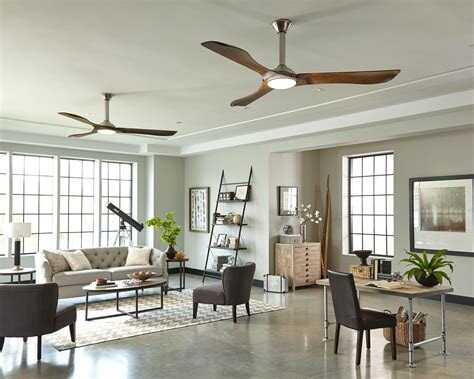
Key takeaway: if you want a ceiling fan that feels high-end in a modern interior, do not start with the brand or the sale price. Start with fit. The best-looking fan is the one whose size, drop, finish, light, and controls all match the room you actually live in.
1) Start with the room before you start with the product page
The biggest mistake is shopping by thumbnail image alone. A fan can look elegant in a white studio set and still feel completely wrong in your home. In a modern interior, scale is everything. Think of the ceiling fan like a coffee table for the ceiling: if it is too tiny, it looks accidental; if it is too chunky, it takes over the whole room.
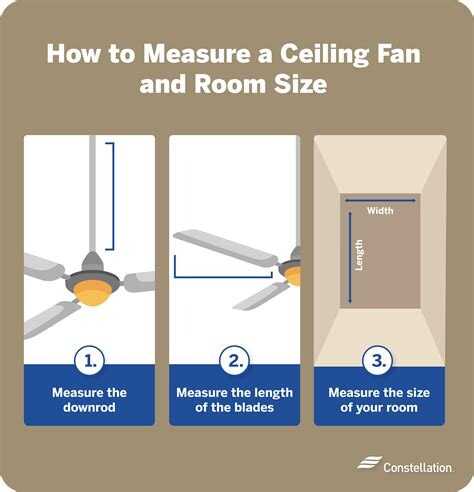
DOE’s current consumer guidance says rooms up to 225 square feet usually suit a 36- or 44-inch fan, while larger rooms should move to 52 inches or more. DOE also notes that in rooms longer than 18 feet, multiple fans usually work better than one oversized unit, and ceilings should be at least eight feet high.
Formula 1: Room area = room length × room width
If your room is 12 feet by 15 feet, your area is 180 square feet. That lands inside DOE’s “up to 225 square feet” range, so you would usually start by comparing 36-inch and 44-inch models. If your room is 16 feet by 18 feet, that is 288 square feet, so you should be looking at 52 inches or larger. This one quick calculation saves you from 80% of bad fan choices.
| Room check | Simple number to use | Good starting fan size | What this means visually |
|---|---|---|---|
| Small to medium room | Up to 225 sq ft | 36″ or 44″ | Keeps the fan proportional and avoids a heavy ceiling look |
| Larger room | Over 225 sq ft | 52″+ | Prevents the fan from looking lost over a sofa, bed, or dining zone |
| Long open room | Over 18 ft long | Two fans | Looks balanced and usually works better than one giant center fan |
Here is how this plays out in normal life. In a studio apartment, you may want one fan to serve the sleeping area and the seating area. In that case, you are not just cooling the room; you are managing visual balance across one open space. In a main bedroom, the fan needs to feel centered to the bed, not just centered to the room. In an open-plan living and dining room, one lonely fan in the middle can make the ceiling look unfinished, while two aligned fans can make the whole space feel designed on purpose.
2) Learn the three visual signals that make a fan look “designer”
Most fans that read as expensive share the same visual habits. They have a cleaner motor housing, fewer visible bits, more controlled finishes, and a shape that feels calm from across the room. You are not really buying “luxury.” You are buying visual quiet.
In a modern interior, three details matter most:
- Profile: slim and uncluttered beats ornate and layered.
- Blade shape: simple blades usually feel more modern than decorative paddles.
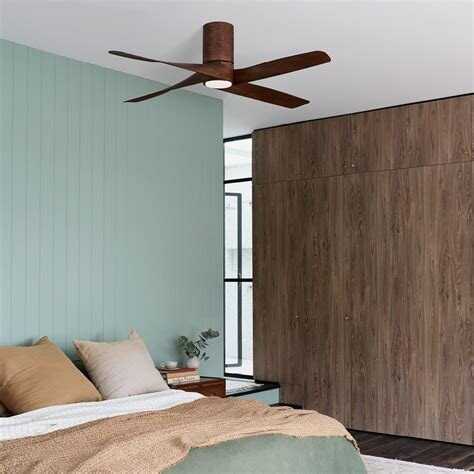
- Finish: matte black, soft white, brushed metal, and warm wood tones tend to blend better than high-gloss chrome or faux-antique detailing.
You do not need a fan that shouts for attention. In fact, the more modern your room is, the more the fan should feel like part of the architecture. A fan over a walnut dining table often looks best with a warm wood or dark neutral finish. A fan in a soft white bedroom usually looks better in white, light oak, or a muted metal than in mirror-shiny nickel.
| Feature | Usually looks modern when… | Usually looks less refined when… | Why your eye notices it |
|---|---|---|---|
| Motor housing | Compact and smooth | Bulky, stepped, or full of trim | Modern rooms reward simple silhouettes |
| Blades | Clean shape, 3–5 blades | Heavy decorative paddles | Too much visual detail makes the ceiling feel busy |
| Finish | Matte black, white, brushed metal, warm wood | Very glossy, fake bronze, mixed random finishes | Modern interiors need color discipline |
The number of blades confuses people all the time. More blades do not automatically mean more style or better performance. Berkeley’s Center for the Built Environment notes that standard fans typically have 3 to 5 blades, and that blade shape, blade number, and blade pitch all affect efficiency and airflow. The same guide explains that airfoil-style blades are typically more efficient and quieter than flat blades. So when you see a three-blade fan that looks minimal and elegant, do not assume it is “less serious” than a five-blade fan. It may actually be the smarter modern choice.
3) Do not let “low profile” marketing fool you
This is one of the most expensive-looking mistakes you can make. People with normal ceilings buy a hugger fan because they think closer to the ceiling must look sleeker. Sometimes it does. But often it just looks flattened and underpowered.
The Berkeley CBE design guide says hugger fans are useful in low ceilings, but they typically have poorer energy performance than standard fans mounted at a more appropriate distance from the ceiling. The same guide says that in higher ceilings, standard ceiling fans should usually hang on downrods so the blades sit about 8 to 10 feet above the floor, and the blade sweep should be at least 18 inches from walls or other vertical obstructions.
That means the “best looking” fan is not always the one glued closest to the ceiling. In a room with enough height, a modest downrod often looks better because it gives the fan breathing room. It also works better. Think of it like hanging a pendant light: too high and it feels accidental, too low and it gets in the way, but in the right position it suddenly makes the room make sense.
Real-life example: imagine a 9-foot ceiling in a calm modern bedroom. A tight hugger fan may look squat and slightly cheap, especially if the motor housing is wide. A slim fan on a short downrod can look lighter, more intentional, and more hotel-like. That is the kind of small choice people notice without knowing why.
4) Buy quiet performance, not just a big airflow number
A designer-look fan still has to live with you at 11 p.m. If you are putting it over a bed, a reading chair, or a work desk, noise matters almost as much as looks. A fan that hums, clicks, or wobbles will make the room feel low quality no matter how pretty the finish is.
ENERGY STAR’s ceiling fan criteria use a weighted efficiency metric called CFM/W, which means cubic feet per minute of airflow per watt of electricity. In plain English, it tells you how much breeze you get for the electricity used. The required minimum efficiency changes by fan diameter, which is another reminder that size and performance belong together.
Formula 2: Estimated annual running cost = (fan watts ÷ 1000) × hours used per day × 365 × electricity rate
Example: if a fan uses 35 watts, runs 8 hours a day, and your electricity rate is $0.20 per kWh, your estimate is 0.035 × 8 × 365 × 0.20 = $20.44 per year. That is why it can make sense to pay more for a quieter, better-built motor if you use the fan every night. The fan becomes part of your daily comfort, not just a decoration.
There is more good news here. ENERGY STAR says certified ceiling fans are up to 44% more efficient than conventional fans, and certified ceiling fans with lights can be 60% more efficient than conventional fan/light units.
For everyday shopping, you can keep performance simple:
- If the fan is for a bedroom, prioritize quiet operation, stable low-speed control, and a warm light you can dim.
- If the fan is for a living room, prioritize right-size airflow and a finish that works with your furniture from across the room.
- If the fan is for a home office, prioritize low motor noise and no distracting light glare.
Key takeaway: do not chase the biggest airflow number without asking where you will sit, sleep, work, and look. The best fan is the one that feels invisible while it is doing its job.
5) Get the light and controls right before checkout
This is where modern interiors often go wrong. You find a beautiful fan, but the integrated light is too cold, too bright, too weak, or just awkward. Suddenly the room feels less warm, less expensive, and less finished.
The Berkeley CBE guide says many ceiling fans are sold with built-in lighting, but typical fan lights can be insufficient for many applications. It also warns about flicker or strobing when fan blades pass through the beam of a light source; ideally, light fixtures should not be placed directly above the fan blades, and layout should be coordinated so the light beam does not intersect the fan sweep.
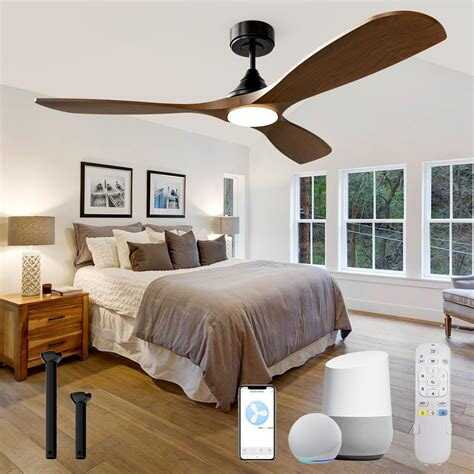
That gives you a very practical rule: if lighting really matters in the room, do not expect the fan to solve everything alone. In a bedroom, a fan light can be enough if it is warm and dimmable. In a living room or dining room, it is usually smarter to let lamps, sconces, or recessed lights do more of the atmosphere work while the fan stays visually quiet.
Controls matter too. If you like simple living, a wall control or remote may be perfect. If you already use smart home platforms, check for Matter compatibility instead of trusting vague “smart” marketing. The Connectivity Standards Alliance says Matter is designed so devices from multiple brands work natively together with secure, reliable connectivity, and a current manufacturer example from Big Ass Fans shows that Matter-ready residential ceiling fans can support core controls like voice control, speed, light brightness, color temperature, scenes, and some sensors. That same example also shows a useful warning: not every brand-specific auto mode or schedule comes through Matter, so you should read the feature list instead of assuming full parity with the brand’s own app.
6) Use current shopping filters that actually save you time
If you feel overwhelmed, that is normal. The market is crowded. But you do not need to compare everything.
At the time of checking in March 2026, the ENERGY STAR Product Finder listed 1,311 certified ceiling fans, including 188 marked “Most Efficient”. That gives you a much cleaner starting point than random marketplace browsing. You can use the official filter set to narrow by product type, brand, and whether a fan is in the “Most Efficient” group, and you can also check for rebates.
A fast modern-home shopping workflow looks like this:
- Measure the room.
- Decide whether you need a hugger, a short downrod, or a standard drop.
- Choose one finish family only: black, white, brushed metal, or warm wood.
- Decide whether the light is decorative, functional, or optional.
- Filter for ENERGY STAR first, then compare style.
- If you care about smart home control, filter for Matter or platform compatibility last.
This order saves you from a common trap: falling in love with a fan that was never right for your room in the first place.
7) Avoid the four mistakes that make even an expensive fan look wrong
Mistake 1: Buying too small because you want it to “disappear.”
In modern interiors, subtle does not mean undersized. A fan that is too small over a large bed or wide seating area does not disappear; it looks accidental.
Mistake 2: Choosing a hugger fan for a normal-height room.
You think you are getting a sleek profile, but you may be giving up both airflow and elegance. If your ceiling height allows it, a short downrod often looks and works better.
Mistake 3: Letting the fan light do all the lighting work.
That is how you end up with a room that feels flat, glaring, or oddly dim. In many living spaces, layered lighting still wins.
Mistake 4: Treating “smart” like a yes-or-no checkbox.
Smart features are useful only when they match how you live. If you never use voice assistants, you may be happier with a quiet remote. If you already run routines in Apple Home, Google Home, Alexa, or SmartThings, Matter support can be genuinely convenient.
| Everyday situation | Prioritize this | Skip this | Good modern setup |
|---|---|---|---|
| Small apartment living room | Right scale and clean finish | Huge industrial look | Compact 36″–44″ fan in white, black, or light wood |
| Main bedroom | Quiet motor and dimmable warm light | Cold bright integrated LED only | Minimal fan with remote and low-speed comfort |
| Open living + dining space | Balanced layout and enough airflow | One small center fan for the whole area | One larger fan or two aligned fans, depending on length |
| Home office | Low noise and no glare | Distracting light beam through blades | Quiet fan plus separate task lighting |
6 useful links that make shopping much easier
- DOE Fans for Cooling — a plain-English government guide to room size, fan diameter, rotation direction, ceiling height, and comfort tips.
- ENERGY STAR Ceiling Fans — an official overview of what the certification means and why efficient fans matter.
- ENERGY STAR Product Finder for Ceiling Fans — a practical comparison tool to filter certified models, “Most Efficient” picks, and rebate options.
- Connectivity Standards Alliance: Matter — the official place to understand what Matter compatibility really means for smart-home control.
- CBE Ceiling Fan Design Guide — a deeper guide from Berkeley if you want help with mounting height, clearances, lighting coordination, and airflow logic.
- Architectural Digest’s stylish ceiling fan roundup — useful when you want to train your eye on what reads as modern, warm, and design-forward.
So what should you buy?
If you want the shortest honest answer, buy the fan that matches your room in size, drop, finish, and lighting role before you obsess over extra features. That is the real secret. A designer-look ceiling fan is rarely the flashiest one. It is the one that makes the ceiling feel calmer, the air feel better, and the rest of the room look more intentional.
If your style is soft modern, lean toward white, light oak, or brushed finishes. If your room is sharper and more architectural, matte black can look amazing. If the ceiling is normal height, do not automatically default to a hugger. If the room is long, do not force one fan to do the work of two. If lighting matters, do not expect the fan light to carry the whole space. And if you love smart-home convenience, check what the fan can actually do in your platform, not just what the box promises.
One last practical thought: when you narrow your shortlist, do not compare ten fans side by side. Compare three. One fan that is safest visually, one that has the best efficiency and quiet-use specs, and one that gives you the best mix of both. That simple comparison method keeps you from getting lost and usually leads to a choice you will still like a year from now.
Final takeaway: the best modern ceiling fan is not the trendiest one. It is the one that fits your room so well that guests notice the room feels good before they notice the fan itself.